I Left My Law Career to Grow Apples in Vermont. A Hailstorm Took Everything, Then Brought Her to My Door
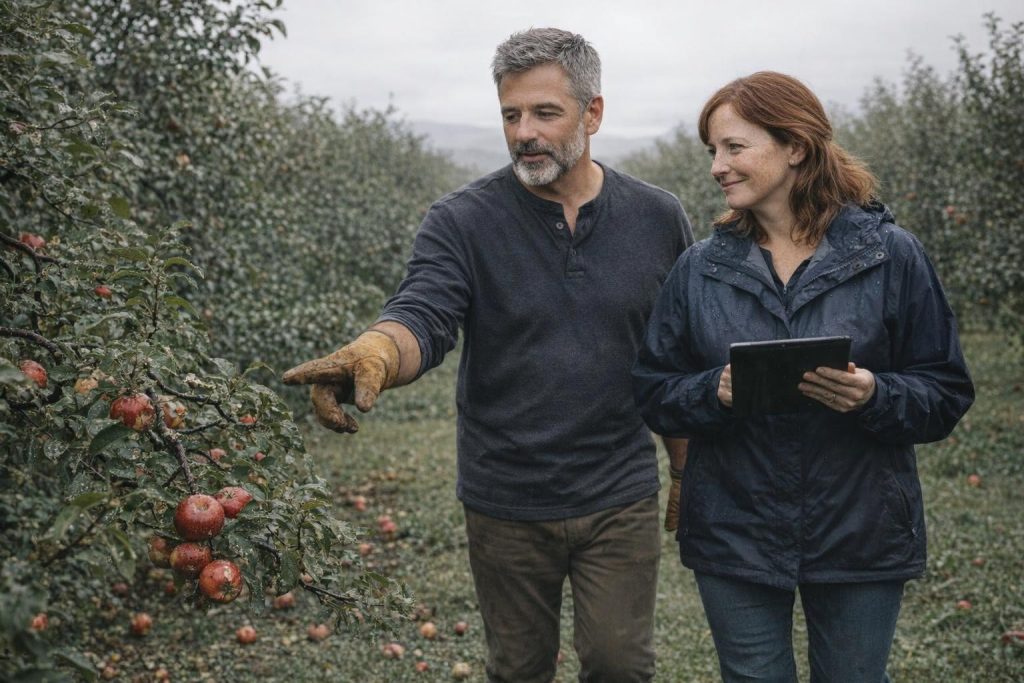
“Ellen Hayes,” she said, shaking my hand. “I’m sorry about your orchard. Let’s go see what we’re working with.”
Ellen was 49. She’d grown up on a dairy farm in New Hampshire, which explained the boots and the way she walked the rows like she belonged there.
She didn’t rush.
She checked tree after tree, counted damaged fruit in sample blocks, photographed bark wounds, asked about my yield history and my production records. She explained every step of the insurance claim process to me, including the parts I didn’t want to hear.
“Your policy covers the lost crop,” she said. “It doesn’t cover damage to the trees themselves. But you should look into the USDA disaster assistance programs. Some of them cover tree replacement for orchards hit like this.”
As a former lawyer, I had read a lot of contracts.
Nobody had ever explained one to me that honestly.
At the end of the second day, we were standing in the last row, and she picked up one of the bruised apples off the ground.
“You know these are still perfectly good for cider, right?” she said.
I blinked.
“Hail damage is cosmetic,” she said. “Grocery stores won’t take them. But hard cider, sweet cider, apple butter… My dad used to say a bruised apple tastes the same as a pretty one.”
I looked around my orchard.
Thousands of bruised apples.
That night, I couldn’t sleep. I sat at my kitchen table with a legal pad, the way I used to before big negotiations, and I wrote a business plan.
Ellen came back the following week to finish the claim.
Before she left, I asked her if she would have dinner with me.
She smiled, but she shook her head.
“I can’t,” she said. “You’re a claimant. I’m the adjuster. That’s a conflict of interest, and you of all people know that.”
I did know that.
“But,” she added, opening her car door, “claims usually close in about six weeks.”
Then she drove away.
Those were the longest six weeks of my life.
I used them well. I took out a small business loan, rented a used cider press, and turned my grandfather’s old recipe into something I could sell. The restaurant in Burlington bought my first fifty cases of hard cider before they even tasted it. The farmers market sold out every Saturday.
The insurance payout covered my losses. The cider covered my mortgage.
On the morning I got the letter saying my claim was officially closed, I called Ellen.